

Our Unique Mission
The Student Podcasters Association exists to give collegiate podcasters a home. It is designed to recognize student podcasters, connect them with professional resources, strengthen campus podcasting communities, and elevate podcasting as a serious and lasting part of college media.
As an initiative of the College Radio Foundation, SPA is building the first international association created specifically for the collegiate podcasting generation. The organization brings together students, faculty advisors, and campus programs around a shared goal: helping student podcasters create stronger work, gain wider recognition, and see a clearer path into the future of audio storytelling.
SPA supports that mission through a growing international network built on membership, training, recognition, and community. Its model includes international memberships for students and institutions, the Dead Podcasters Society as a campus chapter and honors pathway, a student podcasting competition, workshops and guest speakers, and the future development of conference and certification opportunities.
At its core, SPA believes student podcasters deserve the same kind of professional identity and support structure that student journalists and broadcasters have long enjoyed. Whether a student hosts, produces, edits, or builds a show behind the scenes, SPA is meant to help make that work visible, credible, and connected to something larger than a single campus.
We currently offer inaugural individual and institutional charter memberships.
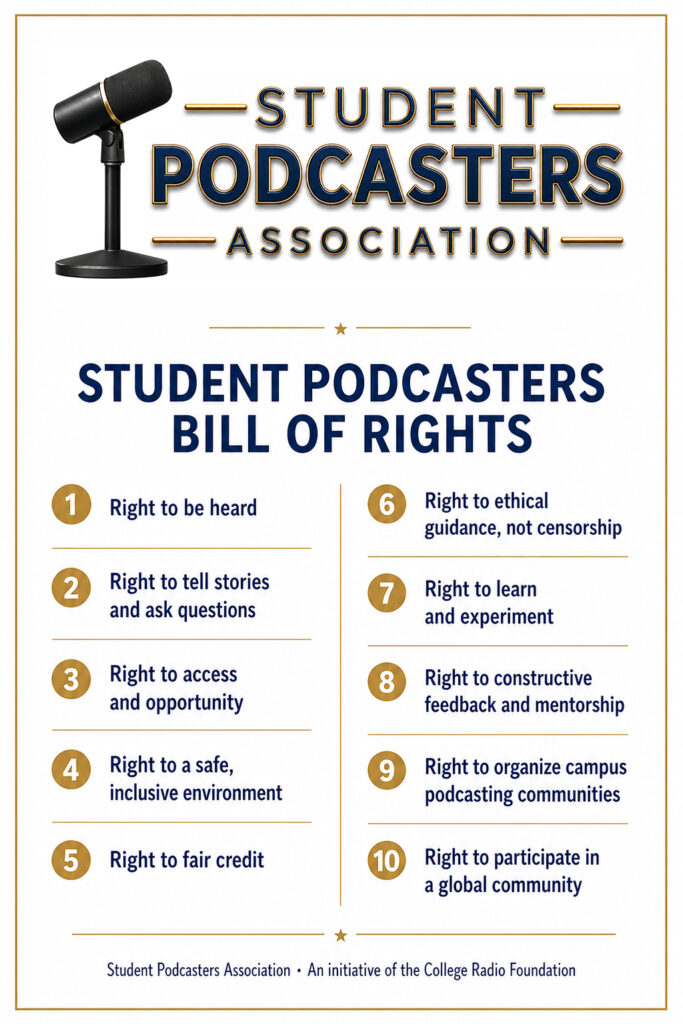
Student Podcasters Bill of Rights
Guiding principles for the Student Podcasters Association
The Student Podcasters Association is founded on the belief that student voices matter. These principles are intended to undergird SPA, its chapters, and its programs, and to give student podcasters and advisors a shared language for how creative and journalistic work should be supported.
1. Right to be heard
Every student, regardless of race, gender, ethnicity, nationality, religion, disability, sexual orientation, socioeconomic background, or identity, has the right to have their voice heard and treated with respect in podcasting spaces.
2. Right to tell stories and ask questions
Student podcasters have the right to tell meaningful stories, explore difficult topics, ask hard questions, and create work that reflects their lived experiences, as long as they uphold ethical and legal standards.
3. Right to access and opportunity
Students have the right to fair access to training, equipment, mentorship, competitions, and recognition. Opportunities offered through SPA and its chapters should be available on equal terms and not restricted by bias or favoritism.
4. Right to a safe, inclusive environment
Student podcasting communities should be free from harassment, discrimination, and bullying. Members have the right to work, learn, and collaborate in environments that are physically, emotionally, and culturally safe.
5. Right to fair credit
Hosts, producers, editors, writers, engineers, and all contributors have the right to accurate credit for their work. Behind‑the‑scenes roles are recognized as essential creative and technical contributions.
6. Right to ethical guidance, not censorship for convenience
Student podcasters have the right to clear editorial and ethical standards, and to receive guidance when work raises complex issues. Content decisions should be based on ethics, accuracy, and safety—not on suppressing uncomfortable but legitimate ideas for convenience.
7. Right to learn and experiment
Students have the right to learn podcasting skills, try new formats, and develop their voices over time. Mistakes, when addressed responsibly, are part of the educational process, not grounds for exclusion.
8. Right to constructive feedback and mentorship
Student podcasters have the right to receive constructive, good‑faith feedback from advisors and peers, and to expect that criticism will be focused on improving the work, not diminishing the person.
9. Right to organize campus podcasting communities
Students have the right to form and participate in campus podcasting clubs, chapters, and communities, including SPA and Dead Podcasters Society chapters, within the policies of their institutions.
10. Right to participate in a global community
Student podcasters have the right to connect with peers, mentors, and audiences beyond their own campus. SPA affirms that student voices from any country, institution type, or background can be part of an international community of collegiate podcasters.